Recent Posts

Showing posts with label Rate Expectations. Show all posts

Monday, January 31, 2022

Expectations Explain The Secular Collapse In Treasury Yields. Deal With It.


One of my long-running sources of rants is the inability of economics and financial commentators to come to grips with the basics of Treasury valuation. Rate expectations is a relatively simple concept that is the core of all modern fixed income pricing frameworks. Hellfire, it’s even embedded into DSGE models. Nevertheless, academics and other sophisticated commentators keep attempting to put lipstick on the pigs that are alternative explanations for the secular decline in Treasury yields.

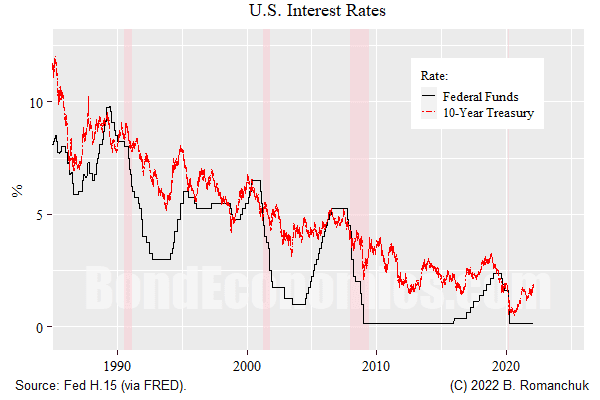
Why can I be so confident in dismissing those alternative explanations? The answer is straightforward: no commentator puts anything other than misleading numbers in their discussion. The chart above — showing the decline in the 10-year Treasury yield since 1985 — explains why.

Depending upon the starting point, the 10-year Treasury yield has dropped hundreds of basis points over time frames longer than the past couple of cycles. (Based on the H.15, 989 basis points since 1985, 613 since 1990, 607 since 1995.) There are no plausible estimates of forward looking 10-year term premia that have fallen by much more than 100 basis points since those dates (all the ones I recall would be 50 basis points or less, but I gave up on reading the term premia literature a long time ago). Meanwhile, the situation would be worse for the 5-year maturity, since rates fell similarly, and term premia are normally estimated to be less significant.

If you read any paper discussing “safe asset demand” or a “savings glut,” that actually contains an estimate of the term premium — and not just economist hand-waving — the term premium due to this effect is invariably moving 50 basis points or less. Just compare that quantity to the absolute change in yields, and ask yourself: why do I care?

Technical Appendix: Why We Can Decompose Rates Into Expectations and a Term Premium

(I will keep this brief, I may expand later into a full article with more details.)

Modern fixed income pricing theory (for credit risk free instruments) will start off with the notion of risk neutral pricing, and we end up with a discount curve that is the expected value of the compounded path of the overnight risk rate. This discount curve is all that is needed to price instruments with a linear payoff with respect to rates — e.g., bonds and swaps without embedded options.

Given a source of swaption/cap pricing, we can then back out the rest of the risk neutral probability distribution without a whole lot of controversy regarding models.

(The main theoretical controversy/difficulty revolves around the correlation of forward rates. What is the pricing relationship between an option on a strip of forward rates (a swap rate is determined by looking at a strip of forward rates) versus individual options on the distinct forward rates within that strip (a cap or floor)? Although this is a hairy problem, it does not matter for linear instruments.)

If we go no further than the risk neutral probability distribution, then bond yields are entirely the result of “expectations” by definition. One can call it a tautology, but there is nothing else to say.

In order for any other factor to appear at all, we need to introduce the notion that there is a bias between market participant’s forecast probability distribution versus the risk neutral distribution. This bias in probability distributions results in the “term premium”: a bias between the observed forward curve versus a hypothetical “unbiased” forecast curve. If factors like an alleged “savings glut” influenced bond yields, they have to live inside the term premium — by definition.

Although most observers accept that term premia exist, there is not a great consensus on what the term premium actually is. (I am skeptical of all the academic models I have seen.) That said, we probably can look at term premia estimate and reject kooky ones based on their behaviour. Very simply, it is going to be extremely hard to find a term premia that “explains” the secular drop in bond yields without it falling to the “kooky” critique.

Email subscription: Go to https://bondeconomics.substack.com/ 

(c) Brian Romanchuk 2022

Friday, August 14, 2020

Understanding The Lack Of Relationship Between Supply And Bond Yields

Academics and strategists have spent decades trying to prove that increased deficits raise bond yields, and publishing a flood of papers that allegedly prove this link. However, nobody competent takes any of those papers seriously. This article outlines why these papers are largely doomed to failure, and are mainly exercises in how to figure out academics tried to lie using statistics.

Sunday, December 8, 2019

Explaining Treasury Yields: Akram And Li Paper (2019)

I just read the recent paper “An Inquiry Concerning Long-term U.S. Interest Rates Using Monthly Data” by Tanweer Akram and Huiquing Li.* The authors look at a wide spectrum of relatively simple models to pin down the explanatory factors for Treasury yields. They find that their techniques find an effect from fiscal variables, but short rates are a dominant factor. Although I am skeptical of the effect of fiscal variables on bond yields, the results in the paper largely matches what the data say to me.

Wednesday, August 28, 2019

Is The Treasury Market Wrong Because Of Hedgers?

Chart: U.S. Treasury and Mortgage Rates

I have some seen some commentary about hedging demand and Treasury yields. One typical interpretation is that hedging demand is pushing Treasury yields "too low," and so the signal from the yield curve is distorted. Furthermore, one could argue that this represents some form of "bond bubble."

Sunday, August 18, 2019

Yield Curve Articles

There's been a lot of discussion of the yield curve. Rather than repeat myself, I will just provide links to a few of my earlier articles that give background (but any charts are obviously out of date) in case the reader missed them.

A selection of articles from my manuscript on recessions.


An older article from Interest Rate Cycles: The Yield Curve and the Cycle.

Otherwise, I do not see much value in wasting readers' time giving my non-forecasts. The only commentary I can offer is that it is probably a mistake to focus only on domestic data in the United States; the risks are probably coming from external linkages. Meanwhile, I am currently not following international data closely enough to provide much guidance.

Wednesday, March 27, 2019

When Can Yield Curves Fail As Indicators?

Although yield curve slopes are very effective indicators for forecasting recessions, they are not infallible. This article discusses some of the reasons why a yield curve inversion can be a misleading recession signal.

Wednesday, July 18, 2018

The Yield Curve Provides Limited Economic Information

Chart: U.S. Treasury 2/10-year slope

The relentless flattening of the Treasury yield curve has been a topic of ongoing debate -- is this a signal that a recession is near? The key to interpreting the flattening is that bond market participants are not paid to to anticipate economic outcomes (outside the corner case of the inflation-linked market), rather to anticipate the path of short-term rates (and the term premium). The flattening yield curve tells us that market participants (on average) believe that we are near the end of the rate hike cycle, but that does not necessarily mean that a recession is imminent.

Sunday, October 29, 2017

Social Structure And The Determination Of Interest Rates


In The Reformation of Economics, Philip Pilkington argues that societal structure determines the power of creditors and therefore interest rates. He then attacks mainstream financial and economic theories about interest rate formation. Although I agree that institutions matter for the determination of the power of creditors, I see mainstream theories of interest rate formation as adequate within the current institutional structure of developed countries. (Link to my review of The Reformation in Economics.)

Wednesday, March 15, 2017

Fed Hike Cycle: The Long Game

Chart: U.S. Forward Rate Versus Historical Average Short Rate

The Federal Reserve is expected to raise rates this afternoon. I am unsure what the Treasury market reaction will be, but my guess is that it will surprise some people who expect yields to be much higher than they are. This article explains why the Treasury market reaction has been relatively muted thus far.

Wednesday, July 27, 2016

No Need For NGDP Futures, We Have Market-Based Monetary Policy Already

The "nominal GDP futures targeting regime" proposal has once again popped up in internet discussion. I have previously avoided the topic, as nominal GDP futures ("NGDP futures") targeting is an inherently silly idea. The only usefulness of the topic is that it allows us to examine the chain of errors that leads to the recommendation. The justification for nominal GDP futures is that the markets help set monetary policy -- which is exactly the situation right now. Which means that the reason for creating these futures in the first place is flawed; the fact that they cannot be implemented is just icing on the cake. This article discusses the issue of the interaction of markets with central bank policy, and does not attempt to delve into the explanation why nominal GDP futures markets would be useless for policymakers.

Tuesday, September 8, 2015

Fed Tightening Matters - Not Quantitative Tightening

The idea of "quantitative tightening" is floating around -- the idea that foreign central bank sales of U.S. Treasurys will raise yields in the same way that "quantitative easing" (QE) purchasing allegedly lowered yields. Since I do not think that "quantitative easing" did anything (see disclaimer), it is unsurprising that I am unimpressed with such a theory. However, even if you accept the premise behind quantitative easing, "quantitative tightening" has little to recommend it. There is a world of difference between a foreign central bank buying bonds versus the local central bank.

Wednesday, March 11, 2015

Fed Rate Hike Cycles And Bond Yields

Chart: 10-Year U.S. Treasury Bond Yield And Policy Rate


In the post-1990 era, most Treasury bond bear markets are associated with Fed rate hike cycles. (There have been some counter-trend selloffs, such as the “Taper Tantrum” of 2013.) The 1994 episode was a notorious bear market that persisted throughout the hike cycle, whereas later bear markets tended to be more front-loaded, with losses concentrated before the Fed even starts to hike rates. This is what one would expect in an environment where the Fed is transparent about its policy actions.

Wednesday, January 7, 2015

What Does "Fair Value" For Bond Yields Mean?

The term "fair value" for bond yields often comes up in market analysis. The term typically refers to where a model predicts yields will be. Since there are a variety of model types, the exact meaning depends upon context. And since not everyone has the same model, investors can have a wide range of opinions as to what the level of fair value is. Additionally, there are implications for the more academic question of what determines the level of interest rates. Fundamental drivers of interest rates presumably determine fair value, but not necessarily observed interest rates.

Wednesday, October 1, 2014

Should A Central Bank Care About Loanable Funds?

Loanable funds theory appears innocuous: the idea that you can apply standard supply and demand curves to the market for financing. However, there are problems with this approach, as the result of how the financial markets operate in a modern economy. In this article, I look at a recent method of recasting loanable funds into a New Keynesian model, and I show why it is still questionable when put into this more modern format. Central banks are free to ignore "loanable funds" when setting interest rates, even within these mainstream models.


Wednesday, September 24, 2014

Understanding The 30-Year Canadian Government Bond Yield

Chart: 30-Year CGB Yield
In "The Bank of Canada vs the bond market", Nick Rowe queries the low level of 30-year Canadian government bond yields, given where the Bank of Canada thinks neutral is. It is possible to understand this based on relative value considerations. Whether those relative value considerations make any sense is another matter entirely.


Sunday, August 17, 2014

Understanding Central Bank Control Of Interest Rates

One topic that periodically comes up is the issue of whether bond yields are "controlled" by the central bank, or whether they are set by "market forces". The typical context of the discussion is whether the bond markets can force governments to follow certain policies. I am in the camp that the central bank does "control" bond yields, but there are some subtleties in understanding how that control is defined.

Thursday, April 24, 2014

Did Fed Purchases Reduce 10-Year Yields By 140 Basis Points? Probably Not.

In this article, I look at the paper "Official Demand for U.S. Debt: Implications for U.S. Real Interest Rates" by Iryna Kaminska and Gabriele Zinna (of the IMF, but the paper does not represent the official views of the IMF). Their conclusion was that Fed purchases of Treasurys (Quantitative Easing, or "QE") lowered 10-year real rates by 140 basis points. I explain why I question their methodology.


Sunday, February 9, 2014

Primer: Exogenous Versus Endogenous Variables

Figure: introduction.
This primer explains the concept of endogenous variables versus exogenous variables, as those terms are used in economics. Although the distinction between endogenous and exogenous appears simple, there are a lot of subtleties involved when the conversation turns to the real economy and not a particular mathematical model. I illustrate how the same variable can be either exogenous or endogenous, depending upon the needs of the modeller. The example used is critically important to bond investors – the policy rate (e.g., the Fed Funds rate). I also comment on these concepts as used in the analysis of fiscal policy.

Tuesday, October 22, 2013

What Is A Government Bond?

This primer answers the question “What is a government bond?” is in terms of defining what a bond does. The answer is that a government bond is an instrument that drains reserves from the banking system. This is not the standard way of looking at government bonds, but I believe it is the key ingredient explaining why the rate expectations theory provides the best description for bond market pricing. (Note: this analysis does not apply to sub-sovereign governments, like Provinces, States or Municipalities.) One can equivalently say that bonds are "forward money".

Note that I am not discussing the legal/financial structure of bonds, I will eventually write a primer on that topic.

Monday, September 23, 2013

Historical Treasury Term Premia: Huge!


This post is an illustration of the concepts discussed in my primer on the term premium. Although we do not really know what the term premium is at any particular time, historical excess returns over a long period of time should average out near the average term premium. However, those excess returns have been implausibly high. Why this matters: if we do not know what the term premium is, we cannot know what the Treasury bond curve is pricing for the Fed outlook.

In the chart below, I show the behaviour of the realised (historical) excess returns for the 5-year Treasury.


5-year Treasury bond excess returns


To explain the chart, in the top panel we see the 5-year Treasury yield versus the 5-year average of the effective Fed Funds rate for the following 5 years. Since FRED does not yet have a time machine option, the data for the average ends in 2008 (i.e., 5 years ago).

In the bottom panel, the “Realised Excess Return” is the 5-year bond yield minus the average fed funds rate depicted above. This is a fairly good approximation of the excess return of a buy-and-hold position in a 5-year bond entered into a particular date versus a cash investment.

For example, in October 2008 (the end point of my sample), the 5-year yield was 2.73%, while the realised average effective fed funds rate since then was 0.16%, generating an excess return of  2.57%.

The table below shows the average realised excess returns for various periods, for the 2-, 5-, and 10-year points on the Treasury Curve. (Charts for the 2-year and 10-year are at the bottom of this post.)

Maturity
Start Date of Data
Mean Excess Return


Entire Dataset
Since 1980-01-01
Since 1990-01-01
2-year
1976
0.51%
0.80%
0.81%
5-year
1962
0.77%
1.95%
1.74%
10-year
1962
1.01%
3.02%
2.56%

The experience for the 5-year maturity is particularly interesting. The negative premia pre-1980 could be explained by the various regulations that led to “financial repression”: yields held below what market forces would suggest. Once the deregulation of interest rates was completed, the premium has not been significantly been negative. Although the disinflation post-1980 was a surprise, the disinflation was largely finished by 1990. The market did not catch on to this, and the 5-year yield was on average 1.74% above the realised fed funds rate since 1990. In my opinion, the historical premium appears outsized for the amount of price risk associated with a 5-year bond; for example it is about double 5-year investment grade spreads right now (using the CDX index). Such a persistent miss by the market is hard to explain if it is in fact efficient.

This makes it hard to calibrate a model for calculating the “true” expected path of interest rates after adjusting for a term premium. If we blindly applied the post-1990 premium to the current curve, the implied expected average fed funds rate over the next 5 years is around -0.25%. This does not appear very plausible.

This also messes up any models for the fair value of bond yields which are based on historical data. In the post-1990s sample, the whole bond curve exhibited a very large term premium (or else market forecasts were consistently terrible). Therefore you end up basing your model target upon a too-high yield. I believe that this was a common analysis error made for the past 30 years, which explains the persistence of the bull market (whereas excess returns should theoretically be a random walk).

In an upcoming post, I will turn to model-based approaches to calculating the term premium – affine curve models.


10-year Treasury bond excess return


2-year Treasury Bond excess return
(c) Brian Romanchuk 2013